Sumsub Review 2026: Pricing, Features & Alternatives
Last updated: · by James Whitfield
Sumsub is the most complete one-vendor compliance stack in the market – KYC, KYB, AML, transaction monitoring, and device intelligence in a single API – uniquely valuable for crypto and iGaming where multi-layer compliance otherwise forces buyers to manage five point-solution contracts.
Best For
Crypto exchanges, iGaming platforms, and fintech apps needing a full compliance stack (KYC + AML + transaction monitoring) from a single API at transparent per-verification pricing
Avoid If
Organizations with strict data sovereignty requirements needing on-premise deployment – Sumsub is cloud-only with limited published data residency options
Price
$$ $1.35 per verification
Integration
LowTrial
Free trial
14-day free trial with 50 free checks
Compliance
- GDPR
- SOC 2
- ISO 27001
- HIPAA
- PCI DSS
- CCPA
Direct link to vendor website
Visit WebsitePrimeBiometry Score
Scored against methodology v2.0 on .
Top Alternatives
See all Biometric Authentication →Pricing Plans
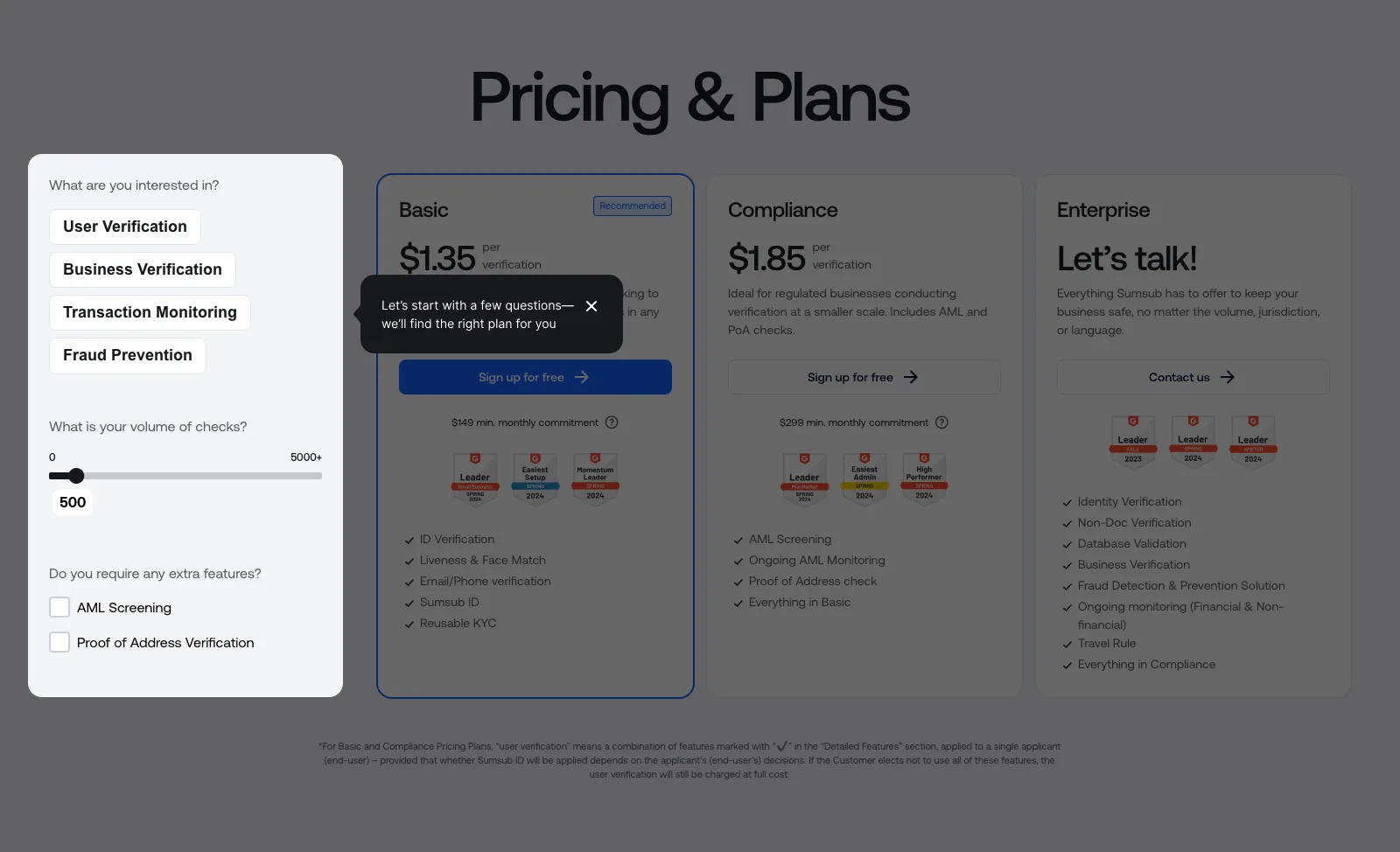
Basic
$1.35 per verification
- ✓ ID Verification
- ✓ Liveness & Face Match
- ✓ Email/Phone verification
- ✓ Sumsub ID
- ✓ Reusable KYC
Compliance
$1.85 per verification
- ✓ AML Screening
- ✓ Ongoing AML Monitoring
- ✓ Proof of Address check
- ✓ Everything in Basic
Enterprise
Let’s talk!
- ✓ Identity Verification
- ✓ Non-Doc Verification
- ✓ Database Validation
- ✓ Business Verification
- ✓ Fraud Detection & Prevention Solution
Capabilities
Captured From Sumsub
PrimeBiometry Assessment
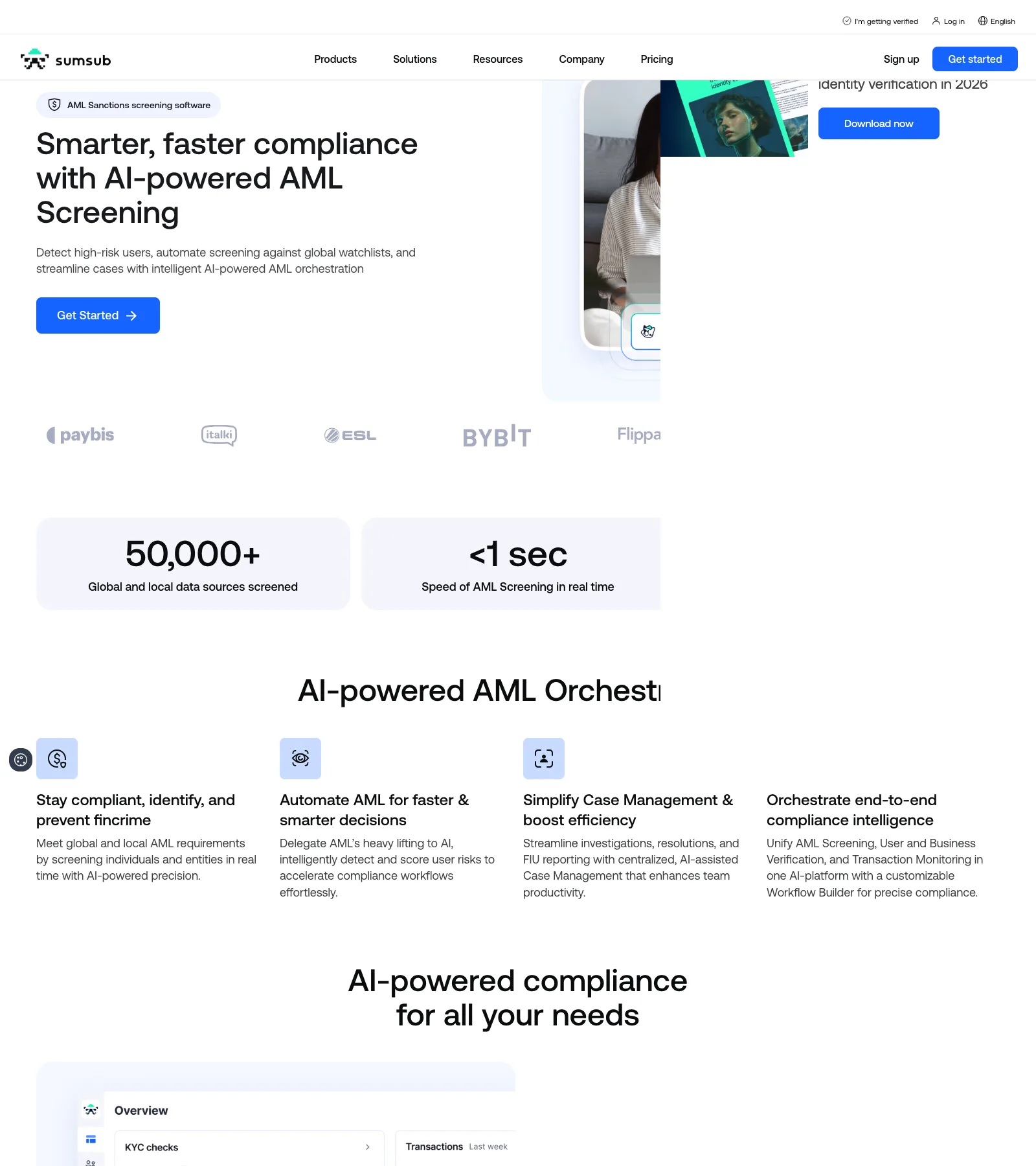
Headquartered in London, Sumsub is the most comprehensive all-in-one compliance platform in this comparison set – covering user verification, business verification (KYB), transaction monitoring, fraud prevention, email/phone risk, device intelligence, video KYC, QES/eIDAS-grade e-signature, Crypto Monitoring, Travel Rule, Case Management, and Workflow Orchestration in a single API contract. The recent additions of QES/eIDAS, Travel Rule, and full Crypto Monitoring close what was previously the biggest gap versus ComplyCube for VASP and licensed crypto exchange buyers. Compliance now carries iBeta PAD Level 1 and eIDAS certification on top of the standing SOC 2, ISO 27001, GDPR, and CCPA posture, and the reusable Sumsub ID network lets verified users skip re-verification across participating platforms. SDK documentation covers React Native, Flutter, native iOS/Android, Web SDK, and REST API at developers.sumsub.com, with a 14-day free trial and 50 free checks that runs on production infrastructure. At 4.6 stars across 112 G2 reviews, credibility is strong among developer and compliance audiences alike.
Pricing Analysis
Sumsub 2026 pricing at a glance: Basic $1.35/verification ($149/month minimum) · Compliance $1.85/verification (adds AML screening + monitoring) · Enterprise: custom quote (includes FATF Travel Rule, KYB, Crypto Monitoring, Non-Doc Verification). All tiers include a 14-day free trial with 50 checks on production infrastructure.
At entry tier, Sumsub sits at the median of the three cloud-native leaders – but the bundling logic diverges sharply as compliance requirements grow.
| Vendor | Entry tier | Price/verif | Monthly floor | AML bundled? |
|---|---|---|---|---|
| Sumsub | Basic | $1.35 | $149 | No (add Compliance tier) |
| Veriff | Plus | $1.39 | – | No (add-on module) |
| iDenfy | Basic | $1.35 | $135 | No |
The Compliance tier at $1.85 is the more natural benchmark for crypto and fintech buyers – it bundles AML screening, ongoing AML monitoring, and proof-of-address checks that stack as billable add-ons at Veriff. When comparing total cost of compliance ownership, Sumsub’s bundled pricing often wins against assembling equivalent coverage from multiple vendors.
The Enterprise tier (“Let’s talk”) is where Travel Rule, Non-Doc Verification, Database Validation, business verification, and ongoing financial monitoring live – all critical for regulated crypto exchanges and licensed VASPs subject to FATF requirements. Buyers in this segment should push for volume-tiered Enterprise pricing that covers the full compliance stack (KYC, KYB, AML, Travel Rule, Crypto Monitoring) in a single line item rather than à la carte modules; that is where Sumsub’s bundle discount lever sits.
See full KYC pricing comparison →
FAQ
Does Sumsub support the FATF Travel Rule for crypto exchanges? Yes. Travel Rule compliance is available in the Enterprise tier, covering the FATF requirement for virtual asset service providers (VASPs) to share originator and beneficiary information for crypto transactions above threshold amounts. This is a hard regulatory requirement for licensed crypto exchanges in most jurisdictions and a key differentiator for Sumsub in the crypto vertical. See our Travel Rule protocol comparison for how Sumsub’s TRP and OpenVASP support compares to the rest of the AML market.
What is “Reusable KYC” in Sumsub’s Basic tier? Sumsub ID enables users who have been verified once to reuse their verified identity credential across multiple platforms in the Sumsub network, reducing friction for repeat onboarding. This is similar to AU10TIX’s Reusable Digital ID – relevant for ecosystems where users move between multiple Sumsub-powered products.
How does Sumsub’s device intelligence feature work? Device Intelligence analyzes device fingerprints, signals, and behavioral patterns to detect fraudulent devices – emulators, rooted phones, and devices previously associated with fraud attempts – before a user even submits identity documents. Combined with email and phone risk assessment, this provides a pre-KYC fraud signal layer that reduces costly document verification attempts on high-risk sessions.
Does Sumsub support KYB (Know Your Business) for corporate onboarding? Yes. Business verification is a core product covering UBO identification, company registry checks across multiple jurisdictions, and ongoing due diligence for legal entities. This is particularly relevant for fintech and crypto platforms onboarding institutional clients alongside retail users.
How does Sumsub compare to Veriff for overall compliance coverage? Veriff has stronger published accuracy metrics (99.6% vs. Sumsub’s 99.5%) and broader country coverage (230+ countries with iBeta-certified liveness). Sumsub’s advantage is compliance breadth – transaction monitoring, Travel Rule, device intelligence, and email/phone risk are not available from Veriff. For pure IDV accuracy, Veriff leads; for end-to-end compliance automation in a single contract, Sumsub is the stronger choice.
Is Sumsub legit? Yes. Sumsub is a legitimate KYC/AML vendor founded in 2015, used by 2,000+ companies including Bitpanda, Parimatch, and Miro. 4.6/5 from 112 reviews on G2. The company processes 2M+ verifications per day and has raised significant VC funding.
Is Sumsub safe? Yes. Sumsub holds SOC 2 Type II and ISO 27001 certifications, and is GDPR and CCPA compliant. Data residency options are available in the EU and US. The platform undergoes regular third-party security audits.
Is Sumsub a Russian company? No. Sumsub is incorporated in the United Kingdom as Sum and Substance Ltd (Companies House number 09688671), headquartered at 30 St. Mary Axe, London EC3A 8BF. The company is registered with the UK Information Commissioner’s Office (ICO registration ZA222205) and operates under UK/EU GDPR. The co-founders are of Russian origin and the company had early operations in Russia, but Sumsub is a UK legal entity — not subject to Russian data laws. Data residency is available in the EU and US. For compliance teams evaluating data sovereignty risk, the relevant factors are Sumsub’s UK incorporation, EU data residency availability, and ICO/GDPR oversight — not the founders’ nationality.
Is Sumsub a reliable KYC provider? Yes. Sumsub is one of the most widely deployed KYC platforms in the crypto and iGaming verticals. The primary operational limitation is cloud-only infrastructure – organizations requiring on-premise deployment must look elsewhere (Ondato or Aware). For cloud-native deployments, reliability is well-documented in public customer reviews.
Does Sumsub offer QES/eIDAS-grade electronic signatures? Yes. QES/eIDAS is now part of the Sumsub product catalog, delivering Qualified Electronic Signatures that meet eIDAS Regulation requirements for legal equivalence to handwritten signatures across the EU. This closes a gap that previously forced Sumsub customers to layer in a separate e-signature vendor for regulated onboarding flows in EU financial services.
Which video KYC modes does Sumsub support? Sumsub now supports video KYC as a first-class product, covering live agent-led verification sessions for jurisdictions and use cases where regulators require a real-time video interview (German BaFin GwG, Indian RBI video KYC, and various EU AMLD guidance). This is offered alongside asynchronous document + biometric verification for buyers who need to route only elevated-risk sessions to video.
Pricing and features subject to change. Verify current information directly with the vendor before making a purchasing decision. This content is for informational purposes only and does not constitute procurement, legal, or compliance advice.
Frequently asked questions
What's included in Sumsub's Basic plan?
Sumsub pricing: From $1.35 per verification. Plans available: Basic at $1.35 per verification, Compliance at $1.85 per verification, Enterprise at Let’s talk!.
Is Sumsub a good fit for crypto exchanges?
Crypto exchanges, iGaming platforms, and fintech apps needing a full compliance stack (KYC + AML + transaction monitoring) from a single API at transparent per-verification pricing
How quickly can developers integrate Sumsub?
Sumsub has low integration complexity.
What are the main trade-offs with Sumsub?
Organizations with strict data sovereignty requirements needing on-premise deployment – Sumsub is cloud-only with limited published data residency options
Related Guides
KYC Pricing 2026: $0.55 to $3 per Check
Real KYC prices for Veriff, Jumio, Sumsub, iDenfy, Ondato, and 4 more vendors. Per-check rates, mont…
Veriff vs Jumio 2026: Pricing & Verdict
Veriff vs Jumio head-to-head: $0.80/check vs custom enterprise, iBeta Level 2 liveness, AML coverage…
KYC + AML Architecture 2026: Stack Guide
Inside modern KYC/AML stacks: SDK layers, sanctions screening pipelines, decisioning engines, orches…