Incode Review 2026: Pricing, Features & Alternatives
Last updated: · by James Whitfield
Best For
Growth-stage fintechs and banks needing end-to-end identity verification with anti-synthetic-ID protection and strong UX
Avoid If
Organizations needing published self-serve pricing – all Incode tiers require sales contact and there is no free trial available
Price
$$$ Contact vendor for pricing
Integration
LowCompliance
- GDPR
- SOC 2
- ISO 27001
- HIPAA
- PCI DSS
- CCPA
Direct link to vendor website
Visit WebsitePrimeBiometry Score
Scored against methodology v2.0 on .
Top Alternatives
See all AML →Pricing Plans
Starter
Contact sales
- ✓ Identity verification
- ✓ Fraud detection
Pro
Contact sales
- ✓ Advanced identity checks
- ✓ Business trust
- ✓ KYC compliance
Enterprise
Contact sales
- ✓ Customizable services
- ✓ Dedicated support
- ✓ Scalable solutions
Capabilities
Captured From Incode
PrimeBiometry Assessment
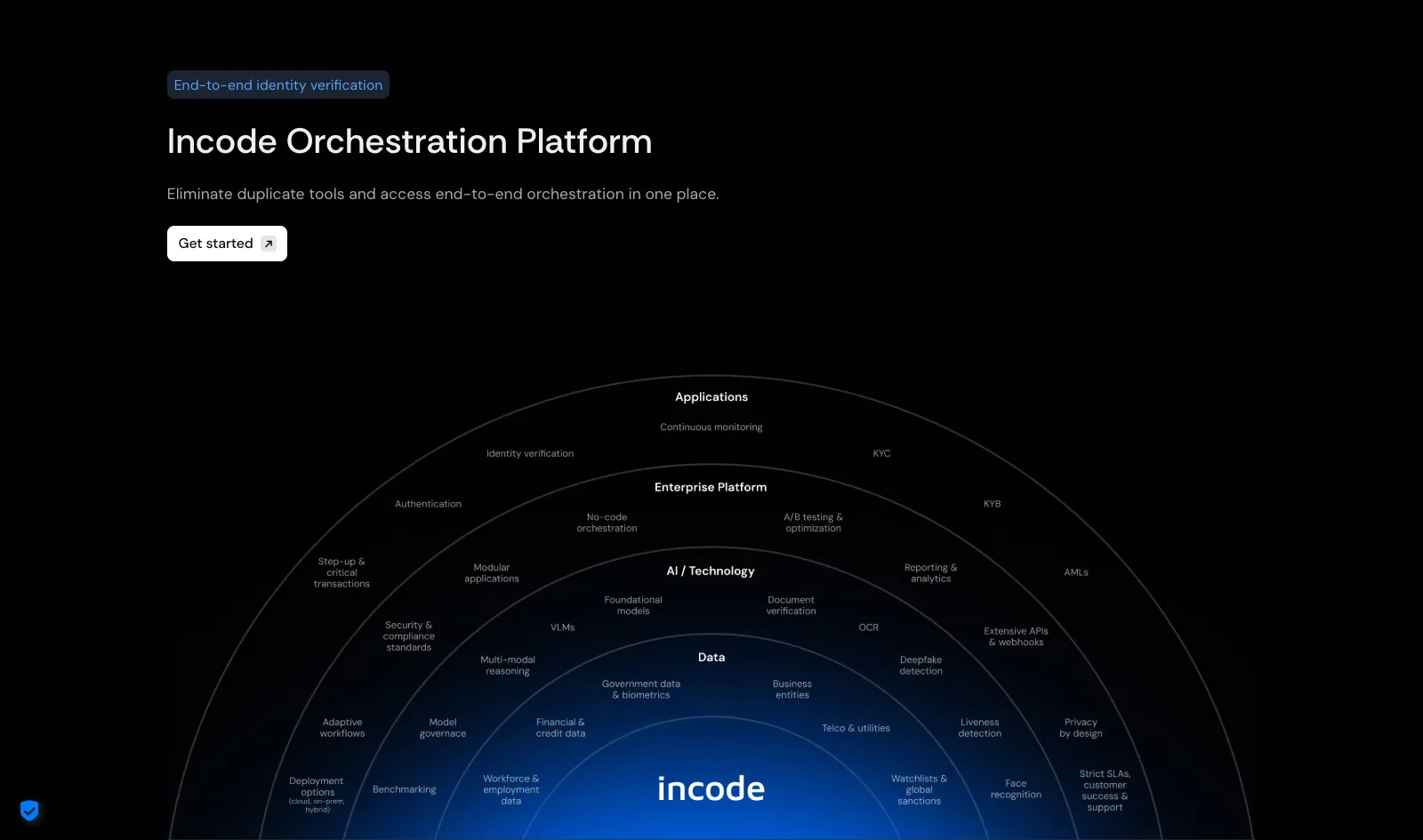
Incode Technologies has positioned itself at the intersection of identity verification accuracy and user experience, backed by $100M in funding and presence across G2, Gartner, and Capterra review platforms. Its technical differentiator is a multi-layer defense against synthetic identity fraud – not just document + selfie matching, but layered signals designed to detect AI-generated or assembled synthetic identities, which have become the dominant fraud vector in digital financial services. With a 5.0 rating across 52 reviews, Incode has one of the stronger public review profiles in this batch, though the “contact sales” pricing across all tiers means evaluation friction is higher than transparent-pricing competitors.
Best For
Growth-stage fintechs, digital banks, and crypto exchanges processing significant onboarding volume that need to balance high conversion rates with robust synthetic ID detection – particularly in markets where AI-generated documents and deepfake selfies are active fraud vectors requiring more than basic 1:1 face matching.
Avoid If
Organizations that need published pricing, self-serve onboarding, or a free trial to build an internal business case – Incode does not offer any of these, requiring full sales engagement before technical evaluation. This is also a poor fit for teams with limited budget for premium platforms.
Compliance Coverage
| Standard | Status |
|---|---|
| GDPR | ✓ |
| CCPA | ✓ |
| SOC 2 | ✓ |
| ISO 27001 | ✓ |
| HIPAA | ✗ |
Integration Complexity
Low – While specific SDK details are not extensively documented in the public data, Incode supports REST API integration across its product suite. The platform spans AML, biometric authentication, identity verification, and KYC Compliance in a unified workflow, reducing the number of integration points compared to assembling point solutions. Buyers should expect 2-6 weeks for full production integration depending on workflow complexity.
Pricing Analysis
Incode’s premium positioning ($100M funding) is contact-only across all tiers. Benchmark against published rates before committing to a sales cycle.
| Vendor | Pricing model | Published rate | Trial | Positioning |
|---|---|---|---|---|
| Incode | Custom | Not published | Contact sales | Enterprise, synthetic ID focus |
| Veriff | Per-verification | From $0.80 | Yes | Cloud-native leader |
| Sumsub | Per-verification | From $1.35 | 14 days, 50 checks | All-in-one compliance |
Starter, Pro, and Enterprise all require contact with the sales team – consistent with enterprise sales strategy but creates a barrier for mid-market buyers doing preliminary budget allocation.
In practice, Incode’s pricing is likely volume-based (per verification) with enterprise minimums. For organizations processing high verification volumes (10,000+/month), the premium pricing may be justified by the synthetic ID detection capabilities and reduced fraud losses. For lower-volume deployments, a transparent-pricing alternative may offer better economics. Buyers should explicitly ask for per-verification rates and monthly minimum commitments to enable apples-to-apples comparison with competitors.
FAQ
What specific techniques does Incode use to detect synthetic identity fraud? Incode’s published differentiator is “multi-layer defense against synthetic IDs.” In practice, this typically combines document forensics, face biometric matching, liveness detection, and behavioral/device signals. Buyers should request a technical whitepaper on the specific synthetic ID detection architecture during evaluation.
Does Incode support AML screening as part of its core platform? Yes. Incode is categorized under AML in addition to KYC, Biometric Authentication, and Identity Verification, indicating that AML screening is integrated into the platform rather than requiring a separate third-party integration.
What is Incode’s coverage for document verification across international markets? The platform covers 254 countries and territories per public documentation, though geographic depth for document types should be confirmed for specific target markets during evaluation.
Is CCPA compliance a strong differentiator for Incode compared to competitors? CCPA compliance is explicit in Incode’s listed certifications, which is notable – many identity verification vendors in this space only list GDPR. For US-based companies with California users, this is relevant for compliance documentation.
How does Incode handle the tradeoff between verification friction and conversion rate? Seamless user experience is a stated design priority for Incode, and high conversion rates are a common claim among B2B identity verification vendors. Buyers should request conversion rate data for deployments comparable to their own user population and device mix, as conversion performance varies significantly by market and document type.
Pricing and features subject to change. Verify current information directly with the vendor before making a purchasing decision. This content is for informational purposes only and does not constitute procurement, legal, or compliance advice.
Frequently asked questions
What's included in Incode's Starter plan?
Incode pricing: Contact vendor for pricing. Plans available: Starter at Contact sales, Pro at Contact sales, Enterprise at Contact sales.
Is Incode a good fit for growth-stage fintechs and banks?
Growth-stage fintechs and banks needing end-to-end identity verification with anti-synthetic-ID protection and strong UX
How quickly can developers integrate Incode?
Incode has low integration complexity.
What are the main trade-offs with Incode?
Organizations needing published self-serve pricing – all Incode tiers require sales contact and there is no free trial available
Related Guides
KYC Pricing 2026: $0.55 to $3 per Check
Real KYC prices for Veriff, Jumio, Sumsub, iDenfy, Ondato, and 4 more vendors. Per-check rates, mont…
Veriff vs Jumio 2026: Pricing & Verdict
Veriff vs Jumio head-to-head: $0.80/check vs custom enterprise, iBeta Level 2 liveness, AML coverage…
KYC + AML Architecture 2026: Stack Guide
Inside modern KYC/AML stacks: SDK layers, sanctions screening pipelines, decisioning engines, orches…